Corporate Sustainability
I. Sustainable Development
We are the cornerstone of healthcare quality; only by respecting life can quality be ensured. The Company values the issues of concern to its stakeholders. Our purpose is to integrate sustainable business thinking into daily operations and to achieve the Sustainable Development Goals (SDGs) together with our customers. Focusing on our core business, we strengthen and integrate cross-departmental resources and internal coordination to implement ESG initiatives. With corporate governance, employee well-being, social engagement and environmental sustainability as our main pillars, we move toward our vision of "becoming a world-class medical software company".
A Chief Sustainability Officer has been established under the Board of Directors.
- Name of the dedicated (or concurrent) unit promoting sustainable development, time of establishment, and authorization by the Board of Directors.
On March 17, 2022, the Board of Directors approved the establishment of a Chief Sustainability Officer, a position concurrently held by Chief Strategy Officer 陳廸智.
- Composition and operation of the promoting unit, and its implementation status for the year (e.g., work plans and responsibilities).
*Corporate Governance Team: Chief Strategy Officer 陳廸智
Responsibilities and tasks: corporate governance structure, code of conduct, Board of Directors, Remuneration Committee, Audit Committee, internal control system, risk management, and business continuity management.
*Customer Care Team: Assistant Vice President of Customer Relations 林珮貞
Responsibilities and tasks: responsible for marketing communications, customer privacy, product and service labeling, and customer health and safety.
*Employee Care Team: Secretary to the Chairman 王思雅
Responsibilities and tasks: responsible for a friendly workplace, employee recruitment and development, and employee care and support.
*Sustainable Environment Team: Manager of Regulatory Affairs and Certification Department 林冠勳
Responsibilities and tasks: responsible for promoting systems related to sustainable development and environmental protection, and for proposing improvement recommendations on: environmental management systems, green products and processes, energy and resource management, greenhouse gas (GHG) inventory, supplier management, and violations of environmental laws.
*Social Welfare Team: Secretary to the Chairman 王思雅
Responsibilities and tasks: responsible for promoting systems related to social welfare and proposing improvement recommendations, community engagement, and social welfare.
(3) Board of Directors oversight: reported to the Board of Directors on August 5, 2024.
II. Award Highlights
| Year | Key Event |
|---|---|
| 1988 | Company founded |
| 1999 | First milestone: completed the first fully filmless hospital in the Chinese-speaking region – Kaohsiung Municipal Siaogang Hospital |
| 2013 | Listed on the Taipei Exchange (TPEx) |
| 2015 | Personal mobile medical cloud (ShareMi) received the 16th Healthcare Quality Award label |
| 2018 | EBM mobile medical imaging workstation Rad@ won the 2018 Top 100 Innovative Products – Gold Award |
| 2020 | UDE obtained U.S. FDA Class II clearance |
| 2022 | Completed the Main-PACS system replacement project at the main campus of National Taiwan University Hospital |
| 2022 | The AI-assisted mammography quality assessment system jointly developed by EBM and the Institute for Information Industry (III) won an R&D 100 Award in the Software/Services category |
| 2023 | 32nd Taiwan Excellence Award – Mobile Medical Imaging Server App (UDE) |
| 2024 | National Innovation Award (Continuous Innovation) – Mobile Medical Imaging Server App |
| 2024 | National Innovation Award (Continuous Innovation) – Medical Imaging AI Integration Platform |
III. Corporate Governance
1. Corporate Governance Structure
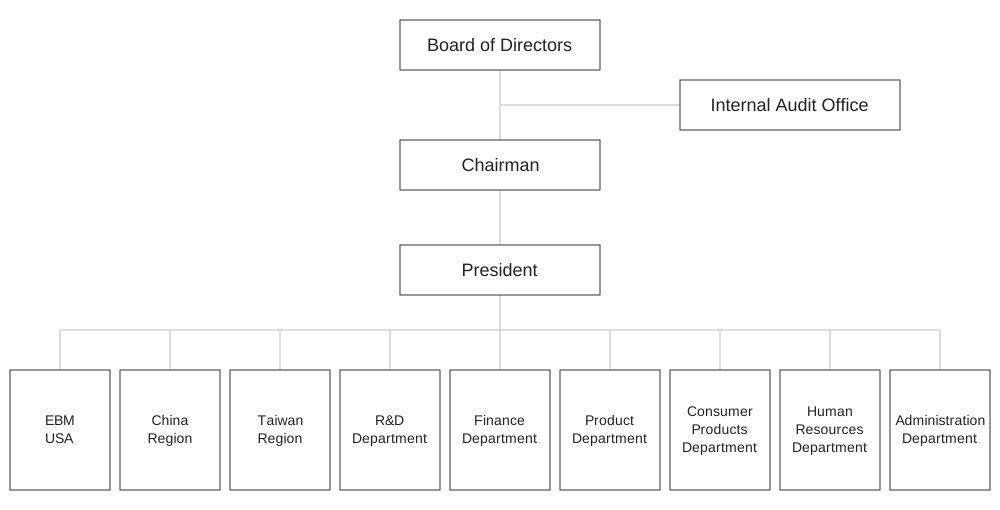
2. Board of Directors and Operating Mechanism
a. Members of the Board of Directors
盤 龍, 林俊堯, 杜文瑋, 黃世貝, 鄭明媛, 林星宏 (Independent Director), 胡惠森 (Independent Director), 陳逸勛 (Independent Director), 曾正忠 (Independent Director)
b. Board Diversity Policy
(1) In accordance with Article 20 of the Company's "Corporate Governance Best Practice Principles", to achieve the ideal goals of corporate governance, the Board of Directors as a whole shall possess the following abilities:
Ability to make operational judgments, ability to perform accounting and financial analysis, business management ability, crisis management ability, industry knowledge, an international market perspective, leadership ability, and decision-making ability.
(2) Board diversity policy, goals and their achievement:
The composition of the Board of Directors shall take diversity into consideration. Except that directors who concurrently serve as managers of the Company should not exceed one-third of the board seats, an appropriate diversity policy shall be formulated based on the Board's own operations, business model and development needs, which should include, but not be limited to, standards in the following two major aspects:
- Basic qualifications and values: gender, age, nationality, culture, etc.
- Professional knowledge and skills: professional background (e.g., law, accounting, industry, finance, marketing or technology), professional skills and industry experience, etc.
To enable the Board of Directors to achieve the above goals and enhance its effectiveness, the Company follows its "Board Diversity Policy". In accordance with the "Corporate Governance Best Practice Principles", the composition of the Board of Directors shall take diversity into consideration. The Company's Board of Directors currently has 9 members, including 4 Independent Directors, with professional fields covering finance and accounting, business, medicine, etc. The Board includes 2 female directors and 2 directors who are also employees; of the 4 Independent Directors, 2 have served for more than 6 years. The Company has always paid attention to gender equality among Board members, and 2 of the current 9 directors are female.
3. Operation of Corporate Governance Units
The Board of Directors met 5 times in the most recent year. Attendance of directors and supervisors was as follows:
| Title | Name (Note 1) | Attendance in Person | Attendance by Proxy | Attendance Rate in Person (%) [B/A] (Note 2) | Remarks |
|---|---|---|---|---|---|
| Chairman | 盤 龍 | 3 | 0 | 100% | Re-elected on June 18, 2025 |
| Director | 林俊堯 | 3 | 0 | 100% | Re-elected on June 18, 2025 |
| Director | 杜文瑋 | 3 | 0 | 100% | Re-elected on June 18, 2025 |
| Director | 黃世貝 | 3 | 0 | 100% | Re-elected on June 18, 2025 |
| Director | 鄭明媛 | 3 | 0 | 100% | Took office on June 18, 2025 |
| Independent Director | 胡惠森 | 3 | 0 | 100% | Re-elected on June 18, 2025 |
| Independent Director | 林星宏 | 3 | 0 | 100% | Re-elected on June 18, 2025 |
| Independent Director | 陳逸勛 | 2 | 1 | 100% | Took office on June 18, 2025 |
| Independent Director | 曾正忠 | 3 | 0 | 100% | Took office on June 18, 2025 |
Evaluation of the independence and suitability of the certifying CPAs:
The Company's Board of Directors regularly (once a year) evaluates the independence and suitability of the certifying CPAs with reference to Audit Quality Indicators (AQIs). The most recent evaluation was approved by resolution of the Audit Committee on March 6, 2025, and subsequently submitted to and approved by resolution of the Board of Directors on March 6, 2025.
The evaluation mechanism is as follows:
Dimension 1: Professionalism – Professional Support
- Indicator 1-1: Audit experience
- Indicator 1-2: Training hours
- Indicator 1-3: Turnover rate
- Indicator 1-4: Professional support
Dimension 2: Quality Control
- Indicator 2-1: CPA workload
- Indicator 2-2: Audit engagement input
- Indicator 2-3: Engagement Quality Control Review (EQCR)
- Indicator 2-4: Quality control support capability
Dimension 3: Independence
- Indicator 3-1: Non-audit services
- Indicator 3-2: Client familiarity
Dimension 4: Supervision
- Indicator 4-1: Deficiencies and sanctions from external inspections
- Indicator 4-2: Improvement letters issued by the competent authority
Dimension 5: Innovation Capability
- Indicator 5-1: Innovation plans or initiatives
Evaluation result: the independence and suitability of the certifying CPAs, as evaluated with reference to the Audit Quality Indicators (AQIs), were found to be compliant in all respects.
External Board Performance Evaluation
On February 1, 2023, the Company engaged "台灣投資人關係協會" to conduct a Board of Directors performance evaluation report.
Implementation:
-
Evaluation questionnaire:
- Distributed to: all directors
- Response rate: 100%.
- Questionnaire evaluation method: the questionnaire uses a scale from 1 (strongly disagree) to 5 (strongly agree).
-
Questionnaire evaluation results:
- Board composition and professional development: 4.71.
- Quality of Board decision-making: 4.84.
- Effectiveness of Board operations: 4.80.
- Internal control and risk management: 4.75.
- Board participation in corporate social responsibility: 4.77.
-
On-site evaluation:
- Evaluation dates: February 6 and February 9, 2023
- Evaluation method: online interviews
- Interviewees: 盤龍, Chairman and President
林星宏, Independent Director (Convener of the Audit Committee)
陳廸智, Chief Strategy Officer and Corporate Governance Officer
Evaluation results and recommendations:
- Establish a "Sustainable Development Committee" as a functional committee > Implemented
- Prepare a Sustainability Report > Implemented
- Establish succession plans for Board members and key management > Under planning
- Establish risk management policies and procedures approved by the Board of Directors > Under planning
- Establish an intellectual property management plan > Implemented
- Amend the Corporate Governance Best Practice Principles to prohibit directors from trading the Company's shares during the blackout period before the release of financial reports > Under planning
- Add one Independent Director seat > Implemented
- Plan Board members' annual continuing education courses early and in a unified manner > Implemented
- Appoint a full-time Corporate Governance Officer > To be determined based on manpower planning
- Submit interim financial reports to the Board of Directors for discussion and resolution > Implemented
- Evaluate the independence and suitability of the certifying CPAs with reference to Audit Quality Indicators (AQIs) > Implemented
- Publish the annual financial report audited and certified by CPAs within two months after the end of the fiscal year > Under planning
- Hold at least 2 Investor Conferences each year > Under planning
IV. Friendly Workplace
1. Employee benefits
The Company has established an Employee Welfare Committee in accordance with the law, which coordinates and organizes various employee welfare activities. The Company contributes welfare funds as required by law to cover the expenses of these activities.
2. Employee continuing education and training, and implementation status
In addition to holding internal training courses from time to time to train employees' professional skills, employees may also apply for external continuing education and training according to their needs.
3. Employee retirement system and implementation status
The Company's retirement system follows the Labor Standards Act. Employees may choose to apply either the old or the new pension scheme, and pension contributions are made monthly to designated accounts.
4. Labor-management agreements and measures to protect employee rights and interests
The Company's labor-management relations comply with the Labor Standards Act. Labor-management meetings are held quarterly, labor relations are harmonious, and no labor disputes have occurred.
V. The Company's Operating Performance and Results Appropriately Reflected in Employee Remuneration
If the Company makes a profit in a year, no less than 1% shall be allocated as employee remuneration, and no more than 2% as director remuneration. However, if the Company still has accumulated losses, an amount to offset the losses shall be reserved in advance, and the remainder shall then be allocated according to the above ratios. Employee remuneration may be paid in shares or cash, and the recipients of shares or cash may include employees of subsidiaries who meet certain conditions. The profit referred to in the first paragraph means the profit before tax for the year before deducting the employee remuneration and director remuneration to be distributed. The distribution of employee remuneration and director remuneration shall be resolved by the Board of Directors with the attendance of at least two-thirds of the directors and the approval of a majority of the directors present, and shall be reported to the Shareholders' Meeting.
VI. Ethical Corporate Management Policy Approved by the Board of Directors, Specific Practices and Programs to Prevent Unethical Conduct, and Implementation Status
On October 11, 2024, the Company provided all employees with awareness training on the Procedures for Ethical Management and Guidelines for Conduct as part of its company rules and regulatory communication. The ethical corporate management policy approved by the Board of Directors is also disclosed on the Company's website.
VII. Whistleblowing System for Internal and External Persons Reporting Illegal (Including Corruption) and Unethical Conduct under the Company's "Procedures for Ethical Management and Guidelines for Conduct"
Handling of unethical conduct involving Company personnel:
When the Company discovers or receives a report that its personnel are involved in unethical conduct, it shall immediately investigate the relevant facts. If it is confirmed that relevant laws or the Company's ethical corporate management policy and regulations have been violated, the Company shall immediately require the person concerned to cease the conduct, take appropriate action, and, when necessary, seek compensation for damages through legal proceedings to protect the Company's reputation and rights.
For unethical conduct that has occurred, the Company shall direct the relevant units to review the related internal control system and operating procedures and propose improvement measures to prevent the same conduct from recurring.
The Company's responsible unit shall report the unethical conduct, its handling, and subsequent review and improvement measures to the Board of Directors.
Handling of unethical conduct by others toward the Company:
When Company personnel encounter unethical conduct by others toward the Company and such conduct involves illegality, the Company shall notify the judicial and prosecutorial authorities of the relevant facts; if public agencies or public officials are involved, the government anti-corruption authorities shall also be notified.
Establishment of reward and penalty, grievance systems and disciplinary actions:
Company personnel who commit serious violations of ethical conduct shall be dismissed or discharged in accordance with relevant laws or the Company's personnel regulations.
The Company shall disclose on its internal website information such as the title and name of the person who violated ethical conduct, the date and content of the violation, and the handling status.
Approved by the Company's Board of Directors: Human Resources Manager 莊信慧 serves as the Ethical Corporate Management Officer
Contact information:
Phone: 02 8751 4567
Email : daphne@ebmtech.com
VIII. The Company's Personal Safety and Environmental Protection Plans:
EBM Technologies Inc. Occupational Safety and Health Management Regulations
Announced and implemented on October 31, 2023 upon approval by the President
1. Purpose:
To effectively prevent occupational accidents at all Company sites and to promote the safety and health of all employees, the "EBM Technologies Inc. Occupational Safety and Health Management Regulations" (hereinafter "these Regulations") are established in accordance with Article 12-1 of the "Regulations for the Occupational Safety and Health Management", requiring supervisors at all levels and personnel involved in management, direction and supervision to carry out the matters stipulated in these Regulations.
2. Scope:
- The scope covers all workplaces of the Company.
- Persons subject to these Regulations refer to employees, visitors and contractors who enter or leave the Company's workplaces due to the nature of their work.
3. Contents of the Regulations:
(1) Occupational safety and health management
- Workers within the Company shall comply with relevant occupational safety and health laws and regulations.
- Each workplace shall conduct identification and assessment of work environment and operational hazards.
- Maintain sorting, orderliness, cleanliness and discipline in each workplace.
- All employees shall undergo regular health examinations and follow the recommendations in the results.
- All employees shall receive relevant occupational safety and health education and training.
- All employees shall follow the safety and health instructions of supervisors at all levels.
(2) Self-inspection:
- If unsafe equipment or conditions are found in the workplace, warning signs shall be posted immediately and the matter shall be reported immediately to the unit supervisor.
- Periodic inspections of specialized technical matters shall be performed by qualified professional contractors, who shall propose improvement recommendations for any unsafe areas.
(3) Contractor management
- Before contracted work is performed, contractors shall be informed of workplace hazards and shall sign a workplace hazard notification form.
- Contractors shall comply with all relevant occupational safety and health requirements and measures applicable to the Company's workplaces.
(4) Accident reporting and handling:
When an accident occurs, necessary first aid, rescue and other measures shall be taken immediately, and an investigation shall be conducted, analyzed and recorded.
Statutory accidents shall be reported to the labor inspection agency within eight hours as required by law. Except for necessary first aid and rescue, the scene shall not be moved or damaged without the permission of the judicial authority or the inspection agency.
- An accident resulting in death.
- An accident with three or more victims.
- An accident with one or more victims requiring hospitalization.
- Other accidents designated and announced by the central competent authority.
4. Responsible Units:
(1) Responsibilities of the President:
- Oversee all occupational safety and health affairs of the Company.
- Approve the Company's occupational safety and health management plan, occupational safety and health management regulations, and work rules.
- Direct all departments to carry out occupational safety and health affairs.
- Other occupational safety and health matters.
(2) Responsibilities of the occupational safety and health affairs supervisor:
- Draw up the annual occupational safety and health work plan.
- Promote and communicate occupational safety and health requirements.
- Plan occupational safety and health education and training
- Support and coordinate occupational safety and health matters among departments.
- Plan and draw up labor safety and health self-inspection plans and work environment monitoring.
- Other occupational safety and health matters.
(3) Responsibilities of department supervisors:
- Carry out occupational safety and health management work.
- Supervise personnel at their sites in complying with the occupational safety and health work rules.
- Conduct job safety analysis and safety instruction.
5. Rewards and Penalties:
(1) Workers at any Company workplace who violate these Regulations and thereby cause an accident shall be disciplined in accordance with relevant rules; those who comply with these Regulations and thereby prevent occupational accidents, with concrete achievements, shall be rewarded in accordance with the rules.
(2) If personnel at any Company workplace fall under any of the following circumstances, they may, pursuant to Article 46 of the Occupational Safety and Health Act, be referred to the Labor Inspection Office of the Department of Labor, Taipei City Government, and be subject to a fine of up to NT$3,000:
- Failure to comply with the occupational safety and health management rules established by the Company.
- Refusal without justification to undergo necessary health examinations.
- Refusal without justification to receive necessary safety and health education and training.
6. Implementation Status:
- Building public safety inspection: once every 4 years, most recently conducted on November 26, 2024 > Compliant
- Participation in 大流 fire safety inspection: once a year, most recently conducted on June 25, 2025 > Compliant
- Participation in 大流 fire drill: once a year, most recently conducted on May 7, 2025 > Compliant
7. Environmental Protection Plans:
-
Greenhouse gas reduction
The Company has installed IoT monitoring equipment for electricity and air quality > records and monitors data for each time period > identifies problems > improves > achieves the goal of energy saving and carbon reduction (the Company occupies an office building and has controlled the efficiency of air-conditioning use as much as possible)
Headquarters electricity consumption: 2022: 164,120 kWh / 2023: 154,080 kWh / 2024: 151,240 kWh.
Target: Reduce electricity consumption by 1% each year.
Implementation status: In 2024, electricity consumption was reduced by 2,840 kWh (1.9%) compared with the previous year.
Offices and the underground parking lot have switched to LED lighting to reduce electricity consumption.
-
Water consumption reduction
The Company has an ESG team > monitors data for each time period > identifies problems > improves > achieves the goal of water saving
Headquarters water consumption: 2022: 1,535 m³ / 2023: 1,507 m³ / 2024: 1,445 m³
Target: Reduce water consumption by 1% each year.
Implementation status: In 2024, water consumption was reduced by 62 m³ (4.1%). Water conservation in daily use is promoted and practiced.
-
Waste management
As a software company, the Company produces no industrial waste. Work processes are now digitized, electronic files are mostly used, and paper use is controlled.
IX. Human Rights Protection Policy and Specific Management Programs
Human Rights Policy: To fulfill its corporate social responsibility and protect the basic human rights of all colleagues, customers and stakeholders, EBM Technologies Inc. respects and complies with internationally recognized human rights norms and principles, including the "Universal Declaration of Human Rights", the "United Nations Global Compact", the "United Nations Guiding Principles on Business and Human Rights", and the core labour standards of the fundamental conventions of the "International Labour Organization", as well as local laws and regulations, in formulating its human rights policy, eliminating any infringement or violation of human rights, and ensuring that all internal and external members of the company are treated reasonably, equally and with dignity.
EBM Human Rights Policy:
- Diversity, inclusion and equal opportunity
- Prohibition of forced and compulsory labor
- No child labor
- Reasonable wages and working conditions
- Healthy and safe workplace
EBM Specific Management Programs:
- Eliminate unlawful discrimination and ensure equal employment opportunities
- Prohibition of forced labor
- Physical and mental health and work-life balance
- Workplace health and safety